As an Amazon Associate this site earns from qualifying purchases.
Spec and compatibility table
| Product | Brand | Stated magnification / objective | Prism & coating | Phone adapter | Tripod | Waterproof | Price |
|---|---|---|---|---|---|---|---|
| 40X60 Monocular | Pankoo | 12X / 60mm | BAK4, fully multi-coated | Yes | Yes | Yes, fog proof | Check price on Amazon |
| 80x100 Monocular | PhysioPhyx | 80X / 100mm | BAK4, fully multi-coated | Yes | Yes | Not stated | Check price on Amazon |
| Mini Monocular | CLNXMT | 25X (2000x25 listed) | Multilayer coating | Yes | Not stated | Weather-resistant | Check price on Amazon |
| 80x100 Monocular, Black | PhysioPhyx | 80X / 100mm | BAK4, FMC lens | Yes | Yes | Not stated | Check price on Amazon |
| 80x100 Monocular, Green | PhysioPhyx | 80X / 100mm | BAK4, FMC lens | Yes | Yes | Not stated | Check price on Amazon |
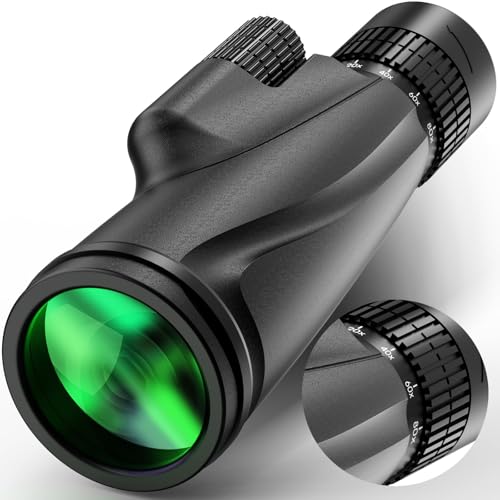
- Adjuatable High Magnification: This monocular has adjustable and powerful zoom magnification, which makes it easier to capture more details, seeing further and clearer; It is
- Compatible with Any Smartphone: Equipped with a quick positioning smartphone bracket and a tripod. It is compatible with a wide range of mobile phone models; It is easy to
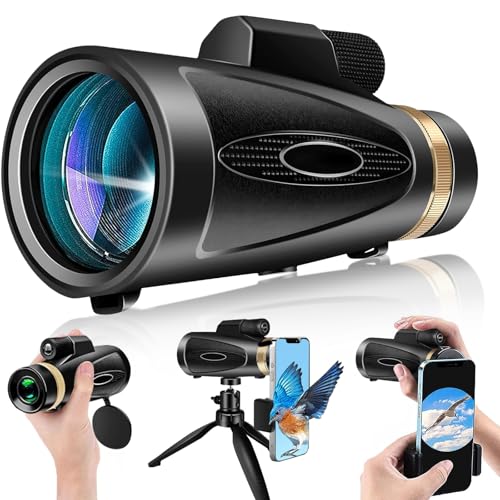
- 80100 High Powered Monocular: High powered monocular telescope provides a 80 times magnification and a large 100mm objective lens for clear and bright images and a broad field of
- High Definition Image: The monocular telescope is equipped with Fully Multi-coated Lens and BAK-4 Prism, which effectively reduces the refraction loss of light and ensures more
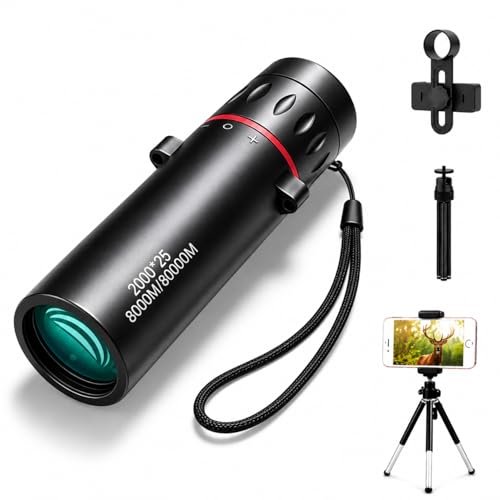
- 10X HD VIEWING & PHOTOGRAPHY – 2000X25 magnification with multilayer coating delivers bright, clear images. Includes phone adapter for capturing photos and videos directly through
- INCLUDES UNIVERSAL PHONE ADAPTER – Comes with a clip-on smartphone holder for easy attachment, turning your monocular into a phone camera lens instantly
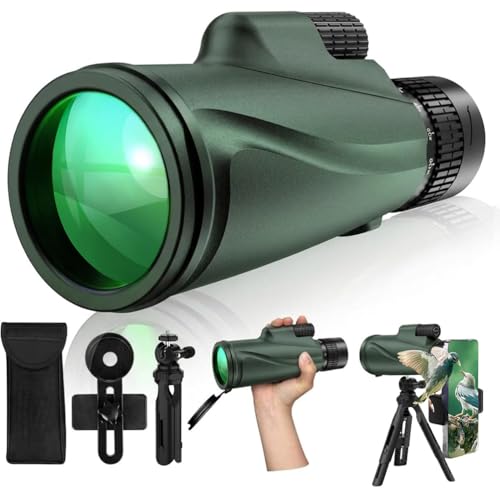
- Adjuatable High Magnification: This monocular has adjustable and powerful zoom magnification, which makes it easier to capture more details, seeing further and clearer; It is
- Compatible with Any Smartphone: Equipped with a quick positioning smartphone bracket and a tripod. It is compatible with a wide range of mobile phone models; It is easy to
How to Connect a Monocular to Your Phone (and Actually Get a Sharp Photo)
Quick answer: A monocular connects to your phone through a clamp-style adapter that lines the phone's camera lens up with the monocular's eyepiece. Nearly every "monocular for smartphone" ships with this adapter and a tripod, so the hardware isn't the hard part — getting the two lenses perfectly centered and steady is. Do that, and you turn a $16–$80 scope into a long telephoto lens for birds, wildlife, concerts, and the moon.
Why phone-mounted monoculars are fiddly
The concept is simple: a monocular is a single-barrel telescope, and a phone adapter holds your camera over the eyepiece so the phone "looks through" it. The problem is that phone cameras and monocular eyepieces have tiny sweet spots. If the two are even a few millimeters off-center, you get a black ring, a dark crescent, or a blurry mess. Everything below is about fixing that.
Step-by-step: connecting the monocular to your phone
- Focus the monocular by eye first. Before the phone touches it, hold the monocular to your eye and turn the focus wheel until your subject is crisp. If you mount the phone before focusing, you'll be chasing focus and alignment at the same time. Gotcha: on dual-focus models like the PhysioPhyx 80x100 with tripod, there are two adjustments — set the coarse focus first, then fine-tune.
- Open the adapter and seat the eyepiece. The adapter has a ring or cup that clamps around the monocular's eyepiece barrel. Push it down fully and tighten so it can't rotate. Gotcha: if the cup slips mid-shot, your alignment drifts. Snug, not gorilla-tight.
- Clamp the phone and slide the camera over the lens. Loosen the phone's spring clamp, drop the phone in, then move it left/right and up/down until the rear camera sits directly over the eyepiece. Gotcha: modern phones have two or three rear lenses — use the main/wide lens, not the ultrawide or telephoto, or the image won't fill the frame.
- Center until the black ring disappears. Open your camera app and nudge the phone a hair at a time. You're looking for the moment the dark vignette opens up into a full circle of image. Gotcha: pinch-zoom your phone camera slightly (2x–3x digital) to crop out any remaining black edges — but don't over-zoom or you'll amplify shake and lose detail.
- Put it on the tripod. Every product here includes a tripod. Thread the monocular (or the adapter) onto it before you shoot anything beyond a snapshot. Gotcha: the included tripods are small tabletop units — set them on a solid surface, not grass or a wobbly railing.
- Fire with a timer or remote. Tapping the screen shakes the whole rig. Use a 2-second timer, the volume-button shutter, or a Bluetooth remote if you have one. Several listings, including the Pankoo 40x60, describe remote operation for exactly this reason.
What goes wrong — symptom and fix
- Black ring or dark tunnel around the image. Symptom: your shot looks like you're peering through a keyhole. Fix: the camera lens isn't centered over the eyepiece. Re-seat the phone and add a touch of digital zoom to crop the edges.
- Everything is blurry no matter what. Symptom: soft, smeary detail even on a tripod. Fix: you skipped focusing by eye. Detach the phone, refocus the monocular manually, then remount.
- Wrong camera doing the work. Symptom: image is tiny and surrounded by black, or won't fill the frame. Fix: your phone auto-selected the ultrawide lens. Force the 1x main lens in the camera app.
- Shaky, streaky photos and video. Symptom: motion blur, especially at high magnification. Fix: high power multiplies every wobble. Use the tripod plus a timer/remote, and avoid windy, unstable perches. This bites hardest on high-power scopes like the 80x100 PhysioPhyx.
- Dim, muddy image in low light. Symptom: usable outdoors but dark at dusk or indoors. Fix: these are daylight optics. A larger objective lets in more light, but none of these replace a true night-vision device — plan for good light.
- Adapter keeps slipping. Symptom: alignment that was perfect drifts after a minute. Fix: tighten the eyepiece cup and the phone clamp separately, and re-check both before each session.
The magnification numbers on some listings read oddly (the Pankoo is titled 40X60 but its features state 12X; the CLNXMT lists "2000X25"). Where a spec conflicts or isn't given, treat the manufacturer's own feature text as the reference and check the current listing before buying.
Finding the right monocular that connects to phone comes down to matching the features to how you will actually use it.
When the fix is a new one
If your current scope fights you on every shot, swapping hardware can solve the task rather than the technique:
- If pocketability and grab-and-go matter more than reach, the CLNXMT Mini Monocular is built around a clip-on universal phone holder and a pocket-sized body — less to align, less to carry, at the lowest price here.
- If you want maximum reach for distant birds or the moon, the PhysioPhyx 80x100 trades portability for a large 100mm objective — just commit to the tripod, because high power makes shake unforgiving.
- If you're shooting in damp or unpredictable weather, the Pankoo 40x60 is described as nitrogen-filled, waterproof, and fog proof, which is the one weatherproofing claim explicitly stated across this group.
FAQ
Does the phone adapter work with any smartphone? The listings describe universal clamp adapters compatible with a wide range of phone models. Very large phones or thick cases can still be a squeeze, so check that your phone fits within the clamp's range before counting on it.
Why does my zoomed photo look worse than what I see through the eyepiece? Your eye is more forgiving of small alignment errors than a camera sensor. Center more precisely, lock it on the tripod, and use a timer so nothing moves at the moment of capture.
Can I record video, not just photos? Yes — once the phone is aligned and on the tripod, video works the same way. Keep the rig dead still, since motion is far more obvious in video at high magnification.
Are these good for stargazing? They can show the moon and bright objects, and the CLNXMT lists stargazing as a use. They are daylight-class optics, though, not astronomy telescopes, so keep expectations to the moon and large, bright targets.
Related guides
- How LensSpan Researches Products
- Editorial Policy and Product Review Standards
- About Us - Our Optics Testing Team and Editorial Mission
Key Takeaways
- Choosing the right monocular that connects to phone means matching the key features to your specific needs and budget
- Read real customer reviews and check the return policy before you commit
- Compare value across models — the priciest option is not always the best fit