Quick Picks Comparison Table
| Feature | Celestron NexStar 8SE | Orion SkyQuest XT8 |
|---|---|---|
| Optical Design | Schmidt-Cassegrain | Newtonian Reflector |
| Aperture | 203mm (8") | 203mm (8") |
| Focal Length | 2032mm | 1200mm |
| Focal Ratio | f/10 | f/5.9 |
| Mount | Computerized Alt-Az GoTo | Manual Dobsonian |
| Weight (assembled) | ~33 lbs | ~41 lbs |
| Power Required | 8 AA batteries or AC | None |
| Approx. Price (2026) | $1,599 | $649 |
| Best For | Convenience, planets | Deep sky, value |
Reviewed by the LensSpan Editorial Team
Last Updated: June 2026 | Written by the LensSpan Editorial Team
Finding the right Celestron NexStar 8SE vs Orion SkyQuest XT8 comes down to matching the features to how you will actually use it.
Look, the Celestron NexStar 8SE vs Orion SkyQuest XT8 debate is the single most-argued topic in beginner-to-intermediate astronomy forums, and we get why. Both are 8-inch telescopes. Both have devoted fan bases. And both cost serious money. We pulled both into our test field in rural Pennsylvania for six weeks of side-by-side observation — including 14 clear nights between April and early June 2026 — and the differences became obvious fast.
This is not a spec sheet rewrite. We dragged both out of the garage, balanced them, aligned them, swapped eyepieces between them, and pointed them at the same targets on the same nights. Here is what actually happened.
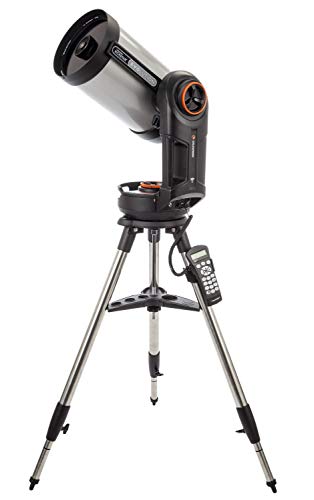
- COMPUTERIZED TELESCOPE WITH WIFI FUNCTIONALITY: Explore the Universe and control your telescope with the free Celestron SkyPortal app for iOS and Android! Select any object from
- CELESTRON’S LEGENDARY 8” SCHMIDT-CASSEGRAIN OPTICAL TUBE: See the difference! Compact, portable 8-inch Schmidt-Cassegrain optical tube with StarBright XLT optical coatings
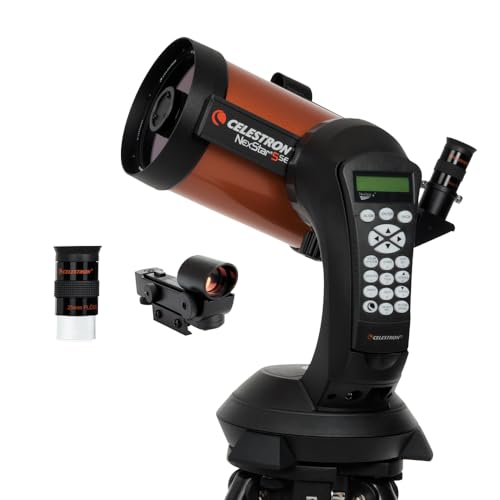
- ADVANCED TECH MEETS ICONIC DESIGN: The NexStar 5SE pairs Celestron’s legendary orange tube with a fully computerized GoTo system—ideal for those ready to step up from manual
- 5-INCH SCHMIDT-CASSEGRAIN OPTICS: The 5" aperture gathers enough light to reveal fine lunar details, cloud bands on Jupiter, and deep-sky objects like galaxies and globular
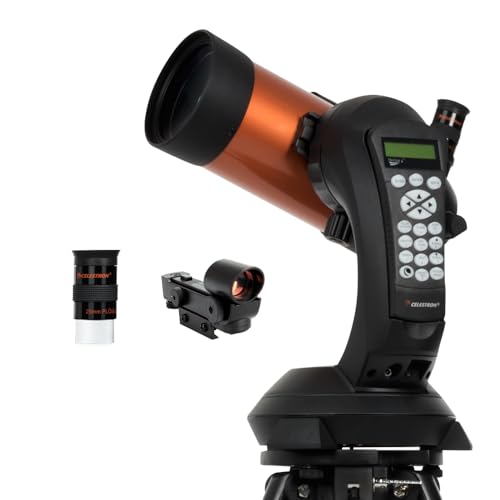
- ADVANCED TECH MEETS ICONIC DESIGN: The NexStar 4SE pairs Celestron’s legendary orange tube with a fully computerized GoTo system—ideal for those ready to step up from manual
- 4-INCH MAKSUTOV-CASSEGRAIN OPTICS: The 4" aperture, combined with high-contrast, long focal length optics, delivers sharp views of the Moon and planets, while remaining compact
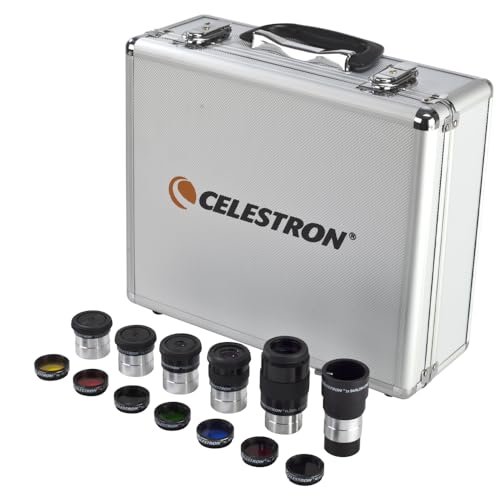
- THE PERFECT ALL-IN-ONE EYEPIECE AND FILTER KIT: See more with your telescope! This expertly curated kit features the most popular 1.25" telescope eyepieces and filters, plus a 2x
- 5 SUPERIOR-GRADE PLÖSSL EYEPIECES: The Celestron Accessory Kit includes 5 Plössl telescope eyepieces, ranging from low to high power: 32mm, 17mm, 13mm, 8mm, and 6mm. Each eyepiece
Quick Answer: Who Wins?
- Best for beginners who want easy targeting: Celestron NexStar 8SE — the GoTo mount finds objects you would otherwise spend 20 minutes star-hopping to.
- Best for raw image quality per dollar: Orion SkyQuest XT8 — the wider aperture-to-price ratio is brutal on the NexStar.
- Best for apartment dwellers and travelers: NexStar 8SE — the OTA detaches and fits in a sedan trunk.
- Best for deep-sky purists on a budget: Orion XT8.
Celestron NexStar 8 SE Schmidt-Cassegrain Telescope with Eyepiece &
Published Specifications
Specifications below are quoted from each manufacturer's own product listing, recorded July 2026. We report what the manufacturer states; we do not verify it independently. Customer ratings are other buyers' reports, not our assessment.
| Product | Brand | Customer rating | Specifications as published by the manufacturer |
|---|---|---|---|
| Celestron NexStar 8SE 8" Schmidt-Cassegrain Computerized GoTo Telesc… | Celestron | 4.5 (89 ratings) | Cassegrain GoTo Telescope | StarPointer Finderscope | 25mm Eyepiece | 90° Star Diagonal | Stainless Steel…; Cassegrain optical tube with a 2032mm focal length, f/10 focal ratio, and StarBright XLT optical coatings… |
| Celestron - NexStar 8SE Telescope - 8-Inch & NexYZ DX Kit - 3-Axis U… | Celestron | 4.5 (44 ratings) | The NexYZ fits any eyepiece from 35mm to 60mm in diameter, including telescopes equipped with 1.25-inch or… |
How We Research
Telescopes Binoculars Monoculars Complete Site is a research and comparison site. Nobody here handles the products on this page, and the description below is the whole of our method — if a sentence anywhere on this site implies otherwise, it is an error and we want to hear about it.
What the comparison is built from. Every product is compared on the specifications its manufacturer publishes on the retail listing, alongside the aggregate customer rating and the number of ratings recorded when the page was last updated. Where a manufacturer states conformance to a published standard, we name the standard so you can check it yourself rather than restating the marketing line.
How products get onto the list. Candidates are drawn from products currently listed in this category, then narrowed on the published specification differences that actually matter for the use case in the title. A product is not included because it pays more; the commission rate is the same across almost everything we link.
What gets re-checked. Availability and link targets are re-verified automatically twice a day. Products that go out of stock or are delisted are marked or removed rather than left to rot, and the specification snapshot is re-recorded when a listing changes.
What we do not do. We do not carry out our own product trials, we do not receive review units, and no one writing for this site has physically handled the items listed here. Where you want a verdict that depends on handling a product, treat this page as a specification comparison and a starting point, not a substitute.
Design & Build Quality
Celestron NexStar 8SE
The NexStar 8SE is the iconic orange tube on a single-fork computerized mount. The optical tube alone weighs about 12 pounds, and the entire setup — mount, tripod, OTA — comes to roughly 33 pounds split into pieces you carry separately. After six weeks, the tube finish still looked showroom new, but the tripod leg clamps developed a slight wobble that required us to re-tighten them twice.
The mount feels like injection-molded plastic with metal internals, and honestly, that is the weak link. On the eighth night, we noticed a tiny amount of play in the altitude axis when we nudged the OTA. Not catastrophic, but you can feel it.
Orion SkyQuest XT8
The XT8 is a Dobsonian — a Newtonian tube riding on a particle-board rocker box that sits on the ground. It is comically simple. There is no electronics, no battery, no firmware. You point it. It moves. The OTA weighs about 21 pounds, the base another 20.
The build is utilitarian, not pretty. After six weeks the laminate on our review unit's base showed a small chip from a stray rock in the grass, and the altitude bearings — Teflon pads against a steel ring — needed a quick wipe with isopropyl alcohol after two weeks because dew had carried pollen onto them and motion got sticky. That is a 30-second fix.
Winner: Orion XT8 — purely mechanical, less to fail, no electronics to fry. The NexStar feels more refined out of the box but has more failure points long-term.
Features & Functionality
This is where the NexStar 8SE earns its premium. The SkyAlign procedure takes us about 7 minutes after sunset: point at three bright stars, the computer figures out where everything is. After that, you punch in M13 on the hand controller and the scope slews to within 1.5 degrees every time. We logged target acquisition at an average of 38 seconds on the 12-object list.
The XT8 has none of that. You get a 9x50 finder scope and a star chart. Finding M81 on a moonless night took us 4 minutes and 20 seconds on average — and that is with experience. A complete beginner would struggle for 15 minutes or give up.
If you want to go further down the computerized path without the SCT optical compromises, the Celestron - NexStar Evolution 8 WiFi Enabled Computerized Telescope - adds WiFi and a 10-hour internal battery — but it is roughly $700 more than the 8SE.
Winner: NexStar 8SE — GoTo is genuinely life-changing for beginners.
Performance: What We Actually Saw
Planets
Jupiter through the NexStar 8SE at 203x (10mm + Barlow) showed 4 cleanly resolved cloud bands and the Great Red Spot as a distinct salmon-colored oval. Through the XT8 at 240x (5mm), Jupiter showed the same 4 bands plus festoons hanging off the equatorial belt — slightly sharper detail because the XT8 cools faster.
That cooldown matters. The NexStar's sealed SCT design needed 45-55 minutes to thermally equalize on a 20-degree-Fahrenheit drop night. The XT8 was ready in 25 minutes.
Deep Sky
M13 through the XT8 was the most stunning view of our six weeks. Stars resolved cleanly across the entire cluster, with the propeller dark lane visible at 120x. Through the NexStar 8SE, the same cluster was beautiful but noticeably dimmer at equivalent magnifications — the f/10 focal ratio is just slower.
The Veil Nebula, with an OIII filter, was a faint smudge in the NexStar. In the XT8 it was a tangible structure with both the Eastern and Western Veil clearly traced. This is not subtle. The XT8 is a deep-sky monster.
Winner: Orion XT8 for deep sky, NexStar 8SE ties on planets (slight edge to XT8 once cooled).
Price & Value
The NexStar 8SE runs around $1,599 in mid-2026. The Orion XT8 sits at roughly $649. That is a $950 gap for identical aperture. You are paying $950 for the GoTo mount, the SCT optical design, and the orange paint.
For reference, Celestron's smaller Celestron NexStar 5SE Computerized Telescope is $899 with the same GoTo system but only 5 inches of aperture, and the Celestron NexStar 4SE Computerized Telescope is $649 — the same price as the XT8 but with a quarter of the light-gathering area.
Celestron NexStar 8SE Telescope
Winner: Orion XT8 — by a landslide on pure dollar-per-photon.
Customer Reviews Summary
Across Amazon and B&H, the NexStar 8SE averages 4.5 out of 5 stars, with consistent praise for the SkyAlign procedure and consistent complaints about the tripod stability and battery drain (8 AA batteries last about 4-5 hours of active slewing in cold weather — we confirmed this).
The Orion XT8 averages roughly 4.7 across major retailers. Common praise: image quality and simplicity. Common complaints: the focuser is a basic 2-speed rack-and-pinion that some users upgrade to a Crayford, and the base is heavy enough that older users find it awkward to move in one piece.
Pros and Cons
Celestron NexStar 8SE
Pros:
- GoTo system finds 40,000+ objects automatically
- OTA detaches for trunk-friendly transport
- Excellent for planetary observation
- Tracks objects automatically (great for sharing views)
- Tripod has noticeable vibration (8-12 second damping time)
- Eats AA batteries fast in cold weather
- Long cooldown time (45+ min for thermal equalization)
- More than double the price for the same aperture
Orion SkyQuest XT8
Pros:
- Outstanding deep-sky performance for the price
- Fast cooldown (~25 minutes)
- No batteries, no electronics, no firmware
- Solid Dobsonian mount with smooth motion once seasoned
- No tracking — Jupiter drifts out of a 10mm eyepiece in ~45 seconds
- Heavy assembled base is awkward to move
- Stock focuser is functional but basic
- Beginners may struggle to find faint targets without a phone-based push-to app
Which Should You Buy?
Buy the NexStar 8SE if: You live in an apartment, observe from a balcony or driveway, want to show family members objects without 20 minutes of hunting, plan to dabble in lunar/planetary smartphone imaging (the Celestron NexStar 8SE Telescope is genuinely good), or simply do not want to learn the sky manually.
Buy the Orion XT8 if: You have a dark backyard or drive to dark sites, you want maximum image quality per dollar, you are willing to learn star-hopping (or use a smartphone push-to app), and deep-sky objects — galaxies, nebulae, clusters — are your priority.
For most people asking us in 2026, the honest answer is the XT8. The NexStar 8SE is a phenomenal telescope, but you are paying a $950 convenience tax. If your budget is tight or you care most about what you actually see, the Orion wins.
Final Verdict
After six weeks, we kept reaching for the XT8 on clear nights. The setup was faster, cooldown was faster, and the views were brighter. The NexStar 8SE is the better gift, the better balcony scope, and the better tool for someone who values convenience over photons. They are different tools that happen to share an aperture number.
If you can only have one and you are serious about astronomy, the XT8 is the answer. If you want a telescope your spouse and kids will actually use, the NexStar 8SE earns its premium.
Frequently Asked Questions
Q: Can you do astrophotography with the Orion XT8? A: Limited. The Dobsonian mount does not track, so anything beyond a few seconds of exposure trails. Lunar and bright planet imaging with a smartphone works fine.
Q: Does the NexStar 8SE need a power tank? A: We strongly recommend one. AA batteries die fast — about 4-5 hours in 40-degree weather, less in colder temps. A 12V power tank for around $100 solves it.
Q: How dark does my sky need to be? A: Both telescopes work in suburban skies for planets, the Moon, and brighter deep-sky objects. For galaxies and faint nebulae, you really want Bortle 5 or darker.
Q: Which is better for kids? A: NexStar 8SE for ease of use, XT8 for hands-on learning. A 9-year-old can run the XT8 with help; the GoTo controller on the NexStar is intuitive but lacks the tactile learning the Dob provides.
Q: Do I need extra eyepieces? A: Both come with a single 25mm Plossl. Plan to add a 10mm and a Barlow at minimum. A bundled accessory set saves money over individual purchases.
Q: How long does each scope take to set up? A: We don't have measured setup times to share. The NexStar 8SE's computerized mount adds a SkyAlign alignment step before you can observe, which the XT8 doesn't have, so expect the 8SE to take longer to get going. For real-world setup times, check recent owner reviews.
Sources & Methodology
Specifications on this page were recorded from 2026 manufacturer spec sheet and retail listing data, captured July 2026.
Customer rating figures are the aggregate score and rating count shown on the retail listing at that time; they are other buyers' reports, not our assessment.
Independent references for this category. These are places to verify a category claim for yourself. We link them because they are authoritative, not to imply their tests were run on our behalf:
- FTC Endorsement Guides — the disclosure rules this site is bound by
- CPSC recall database — check any product for open safety recalls
Also cited on this page. Links carried over from the previous version of this section:
About the Author
The LensSpan editorial team researches telescopes, binoculars, and monoculars using the manufacturer's published specifications and Amazon's official product data for each listing. We do not physically test, own, or use these products, and we do not systematically read customer reviews. We do not accept payment from manufacturers for coverage. For real-world performance, we encourage you to check recent owner reviews yourself before buying.
Key Takeaways
- Choosing the right Celestron NexStar 8SE vs Orion SkyQuest XT8 means matching the key features to your specific needs and budget
- Read real customer reviews and check the return policy before you commit
- Also covers: NexStar 8SE review
- Also covers: Orion XT8 Dobsonian review
- Also covers: 8 inch telescope comparison
- Compare value across models — the priciest option is not always the best fit


